The Ichthyosaurus

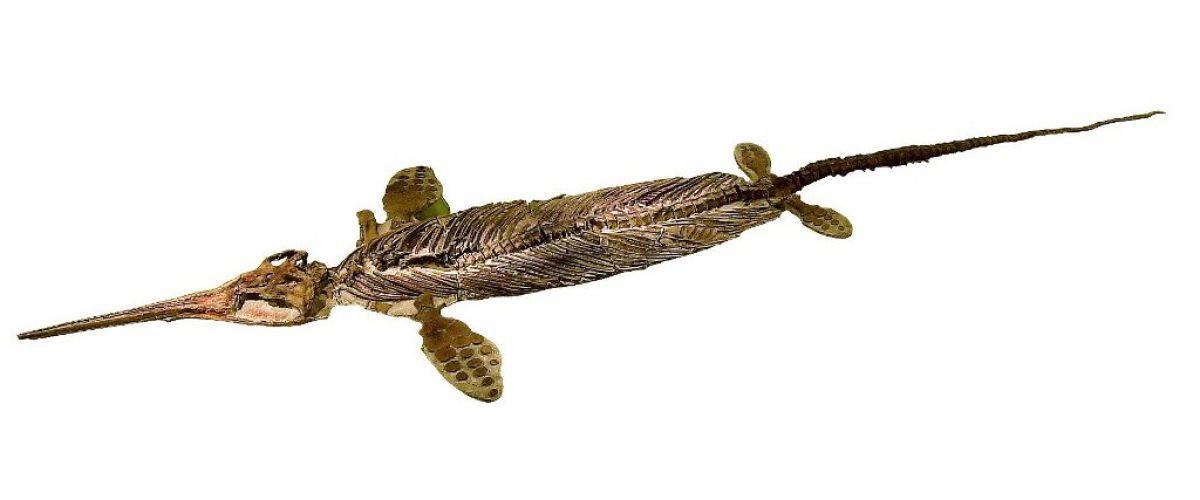
This is a fish lizard, or Ichthyosaurus. The fossil is about 190 million years old.

This specimen is 575 cm long, measured from the tip of its 1.5 meter long skull to the last tail vertebra. The tail itself was not preserved; a cast from another fossil was used to complete it. The fossil weighs 250 kilograms.

The Museon-Omniversum fossil is exceptionally large. Most other Ichthyosaurus fossils are only about 1 meter long. While most are found lying on their side, this one was found lying on its belly. It was discovered in undisturbed rock nodules, preserving it in its original position.

Lyme Regis, South-Engeland

The ichthyosaur at Museon-Omniversum was discovered on the coast of Lyme Regis in southern England, an area famous for its fossil finds. Some of the oldest fossils there date back 195 million years. Fossilized remains of squid, bony fish, crustaceans, and sea lilies have also been found. Many ichthyosaur fossils are flattened from the side, but our specimen is special because it was compressed from above.

Blue Lias formation by Alan Walker, CC BY-SA 2.0, Wikimedia Commons

More information about Ichthyosaurus

Big-eye Ichthyosaurus chevron down

These animals had the largest eyes in the animal kingdom. The ichthyosaur at Museon-Omniversum would have had eyes about 15 cm in diameter (they are not preserved in our fossil), which we can tell from its enormous eye sockets. The largest eyes ever found belonged to an ichthyosaur with the fitting Latin name Ophthalmosaurus.

Ichthyosaurs had a lifestyle similar to that of modern dolphins.

Reptile, mammel or fish? chevron down

Despite their different origins, fish, dolphins, and ichthyosaurs (like the one in our collection) look remarkably similar. They are all swimming animals, yet their differences are significant. Fish have remained in the water since they first appeared, while ichthyosaurs and dolphins evolved from land-dwelling ancestors.

About 50 million years after life first moved onto land (during the transition from the Carboniferous to the Permian), some lineages returned to the sea. The first ichthyosaurs appeared around 245 million years ago. They could actually be called “lizard fish,” because they looked like lizards with fins. In a relatively short time they spread to all the seas and oceans. Their number of species grew rapidly, and their bodies became increasingly fish-like. Around 150 million years after they first appeared, they disappeared again.

Van poot naar vinpoot naar vin chevron down

De eerste vishagedissen hebben lange vinachtige voor- en achterpoten. Bij latere soorten zien we de onderarmbeenderen en de vingers steeds korter en platter worden. Verder groeit het aantal botten en verdwijnt de duim. Op het laatst verschijnen er extra vingers links en rechts aan de hand. De verandering is van een arm met bewegende botten en vingers naar een vin gegaan waarin de botten onbeweeglijk tegen elkaar aan liggen. 

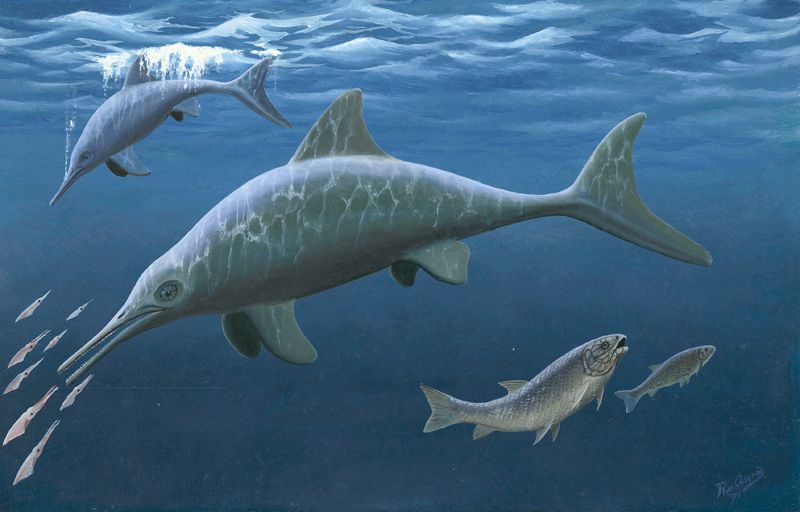
This is likely what the ichthyosaur looked like. chevron down

(Drawing: Rob van Assen)

Adapted to life in the sea chevron down

Fish lizards look more like fish than lizards. They are perfectly adapted to life in the sea. Because they give birth to alive young creatures, they even resemble dolphins. They may look similar, but appearances can be deceiving. Dolphins are mammals, just like us, while fish lizards are reptiles. Yet they share two key traits with dolphins. They can no longer go on land, and they give birth to alive young creatures. They still produce eggs, but keep them inside their bodies. The young hatch internally and are born alive into the sea.

Dinosaurs ruled the land, but ichthyosaurs ruled the seas. Although many fossils have been discovered, we still know little about their origins. One thing is certain: they were not dinosaurs. Some researchers even see connections to sea turtles. Fossilized stomach contents, sometimes very well preserved show that their daily diet mainly consisted of squid.

Conquering the sea chevron down

Swimming like an eel is very useful for animals that need to change direction quickly and live close to or on the sea floor. The earliest ichthyosaurs mainly inhabited shallow seas along the continents. Those that swam more like tuna thrived in the open ocean, moving at a steady speed over long distances. Later, more fish like forms hunted in deeper waters, below 200 meters. Soon after these reptiles returned to the sea, the entire water column became their hunting ground and the distinction between these reptiles and real fish began to disappear.

Reproduction chevron down

Later ichthyosaurs could no longer leave the water to lay eggs on land. They incubated their eggs internally and gave birth to live young in the sea. In this way, they were similar to whales and dolphins, which would appear millions of years later, long after the ichthyosaurs had disappeared from the oceans.

The food depends on their mouth chevron down

Most ichthyosaurs had long, narrow snouts, while some species had shorter ones. These differences reveal something about their diet. We see the same variation in modern dolphins, which we can study more easily to understand their feeding habits.

Learing how to swim again chevron down

The earliest fish lizards still looked a lot like lizards, but with more vertebrae. They probably swam like eels, sending wave like movements from just behind the head along the length of their body. Over time, their bodies became thicker and so did their vertebrae. The vertebrae developed a shape reminiscent of a hockey puck, similar to the flat vertebrae of sharks.

As a result, their swimming became less eel like and more focused on the rear of the body. This movement is similar to that of tuna, which use only the tail end to propel themselves forward. The fins took on a new role, mainly for steering and braking.

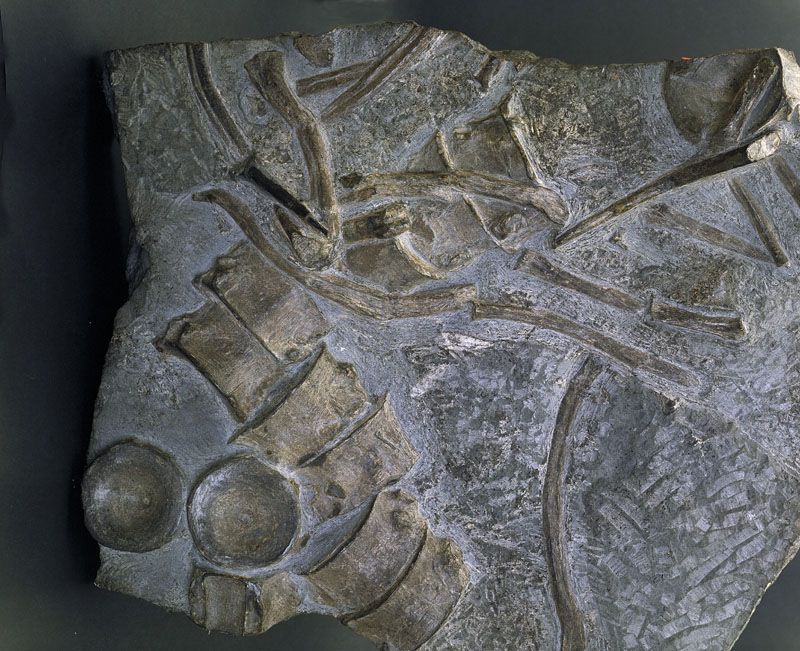
Vertebrae and Ribs of an Ichthyosaurus chevron down

(Foto: Collection Museon-Omniversum)

Hockeypuck vertebrae chevron down

Ichthyosaur vertebrae have a shape reminiscent of an ashtray or a hockey puck. Very few reptiles have vertebrae like these. Their land dwelling, lizard like ancestors had vertebrae that were longer than they were wide allowing the body to bend freely at every point.

In the earliest fish lizards, the number of vertebrae increased making the spine flexible along its entire length. Their movement was eel or snake like. In later ichthyosaurs, the vertebrae remained numerous but became much wider. This made the spine stiffer, and propulsion relied mainly on the tail and rear part of the body.