Knowledge

The deep sea is the largest habitat on Earth. Seventy percent of the planet’s surface is covered by oceans, and of that, ninety percent is deep sea.

We know very little about the oceans because they are simply too vast to explore. In fact, we know more about the universe than we do about our own oceans.

The average depth of the world’s oceans is around 3,960 meters, roughly the height of thirteen Eiffel Towers stacked on top of each other. The deepest point, the Mariana Trench near the Philippines, lies over eleven kilometers down. From that point on the seafloor, the tallest mountain, Mount Everest, would be covered by more than two kilometers of water.

Conditions in the deep sea are extremely harsh. For every ten meters of depth, pressure increases by one atmosphere. The light that penetrates from the surface quickly fades. At 800 meters, only a faint bluish glow remains. Deeper still, at around 1,000 meters, it is pitch black, with no distinction between day and night. Water temperatures rarely rise above two degrees Celsius. Oxygen dissolved in the water is scarce, and food is extremely limited.

Adobestock 767433867

Life in the deep sea

On the bottom of the deep sea

Down to a depth of about 1,000 metres, the sea is full of life: lobsters, sponges, corals and coral reefs. Along the slopes that descend into the deep sea, sharks and predatory fish patrol the waters. But on the ocean floor, everything seems as lifeless as a desert. Yet life exists here as well, even within the seabed itself. In the depths, you may encounter sea cucumbers, which feed on other organisms, as well as sea urchins and deep sea worms. The floor of the deep ocean remains largely unknown to us, a true terra incognita. New and unfamiliar species are still being discovered time and again.

Two types of life

Life at the Earth’s surface depends on the sun. Plants and algae use sunlight to produce food, a process known as photosynthesis. Animals feed on plants, or on other animals that eat plants. You can think of life on land and in most of the oceans, as a solar-powered car: it runs on energy from the sun.

Life around deep-sea vents follows a different path. It does not rely on sunlight, but on chemical energy. Bacteria use chemicals dissolved in the hot water to produce food, a process known as chemosynthesis. Animals feed on these bacteria, or on other animals that eat the bacteria. You can think of this form of life as a car running on fuel: it is driven by chemical energy.

Fish in the deep sea

The depth record for fish is held by an eel like species measuring just seventeen centimetres in length. It lives at a depth of nine thousand metres below sea level. It is remarkable that deep sea fish can survive in such an extreme environment. They live in waters where food is scarce and where no green plants capture energy from sunlight. Instead, they depend on whatever organic material happens to sink down from above. Predatory fish also inhabit the deep sea, hunting the scavengers often waiting for a rare opportunity to pass by. For individual deep sea fish, the greatest challenge is the darkness. Their world is completely without light. To survive, they must be able to locate prey and find a mate in the dark. Many deep sea species have developed very large eyes, allowing them to capture even the faintest trace of light.

Fish without colour

Many deep sea fish are as black as the night. This may serve a purpose for predators: it prevents prey with light producing organs from shining through the stomach wall and potentially attracting other predators, which could put the fish at risk. The black outer skin effectively hides the glowing contents of the stomach. There are also species in which only the stomach is black, while the rest of the body remains lighter. 

Waiting for food

In open deep sea waters, fish often attract their prey with light. Near the seafloor however a different approach is more common. These fish don’t lure their food, they rely on the current to bring it to them. They have long pelvic fins located near the head, which they use to lift themselves off the ground. This keeps their head raised, allowing them to watch their surroundings. Take tripod fish, for example: they have long pectoral fins that reach almost to the head. This lets them keep their head close to the seabed while staying stable in the current, ready to detect any nearby prey.

Glowing fish

Some deep sea fish can produce their own light. Light organs in these fish come in many different forms. Some generate light using special enzymes, while others host bacteria that emit light. Certain species use their light organs like a miner’s lamp. One type of deep-sea predator, for example, has light organs beneath its eyes that produce red light. At these depths, most of the ambient light is blue or green. Most fish have adapted to this and can no longer see red light, but the predator still can. It can use its red light to spot prey without being noticed. It’s a strange and fascinating arms race.

Black Smokers

Where the plates that form the ocean floor pull apart, we find hot springs. These vents constantly release water heated by magma from deep within the Earth. The water, often over 300 degrees Celsius, is rich in dissolved minerals. When it escapes through cracks in the seabed and meets the near freezing seawater, the minerals precipitate out. This process forms the towering chimneys known as Black Smokers.

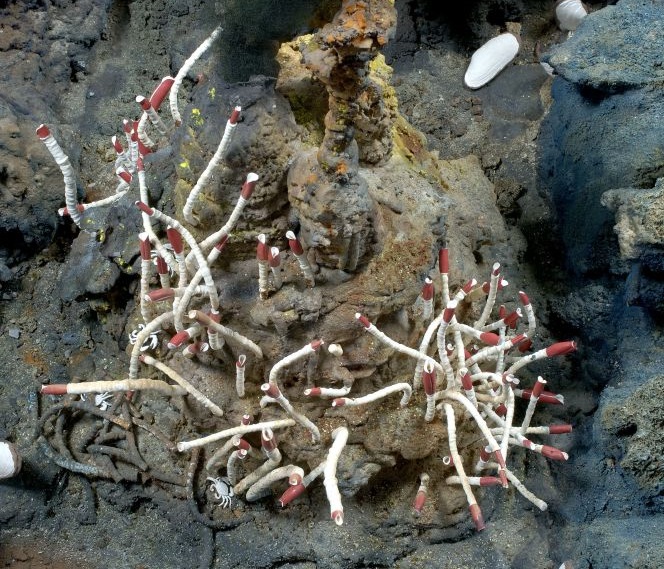
Around the chimneys, the temperature remains steady at about twenty degrees Celsius. Combined with the abundance of minerals, this creates a hotspot for life: white crabs, shells, and countless tiny snails without mouths, stomachs, or intestines. A striking feature is the white tubes of sometimes enormous beard worms, which filter water through their bright red mouths. This extraordinary community, found at depths of over two kilometers, was only discovered in 1977.

Hot or cold water?

How can anything survive in such scorching water? The water emerging from Black Smokers can exceed 400°C, yet it cools quickly as it mixes with the cold seawater around the vent. Just a few centimeters from a Black Smoker, the water can be a comfortable 20°C, while a little farther away it may have dropped to 2°C. Animals thrive in the warm water near these hydrothermal vents.

Tube worms

In the Black Smoker diorama at the top of this screen, you can see tube worms. A tube worm has no mouth or stomach, so how does it survive? The worm absorbs oxygen, carbon dioxide, and hydrogen sulfide from the water to feed the bacteria living inside it. These bacteria produce energy rich chemical compounds that sustain both themselves and their host, the tube worm. This life sustaining partnership is called symbiosis. Tube worms can grow up to 1.8 meters long.

Foto: Model of a blacksmoker from the collectie of Museon-Omniversum

A new way of thinking

Scientists had long known that some bacteria can turn hydrogen sulfide, a toxic gas that smells like rotten eggs into food. But they never expected to find entire food chains based on hydrogen sulfide, coming from deep within the Earth. The discovery of animal colonies around deep sea vents, which release hydrogen sulfide from their chimneys, forced scientists to rethink their ideas about life on Earth… and even on other planets.

Could life exist at underwater vents on other planets? 

Scientists once believed that all life depended on the energy of the sun. But at deep sea vents, life survives on just water, chemicals and heat from deep within the Earth. Today, some scientists think that life on our planet may have begun at these underwater vents. If they are right, it raises the possibility that life could exist on other planets too.