Knowledge
The Proterozoic Era, 2.5 billion to 542 million years ago: the first signs of life

Only toward the end of this immense period, which lasted nearly two billion years, did the first fish begin to populate the seas around 540 million years ago. These early fish had no jaws, but they did have gills. Their mouths were small and better suited to feeding on tiny food sources, such as algae scraped from rocks.
Stromatolites: Living Fossils
The earliest life forms were so small that they left almost no trace behind. The first organisms to leave a clear mark are stromatolites. Although these life forms emerged around three billion years ago, they still exist today.
Along the west coast of Australia, in the tidal zone, you can see small domes and columns reaching about half a metre in height. They grow very slowly. A curious natural formation? It was only in the last century that scientists discovered they descend from the oldest recognisable life forms from the early history of our planet.
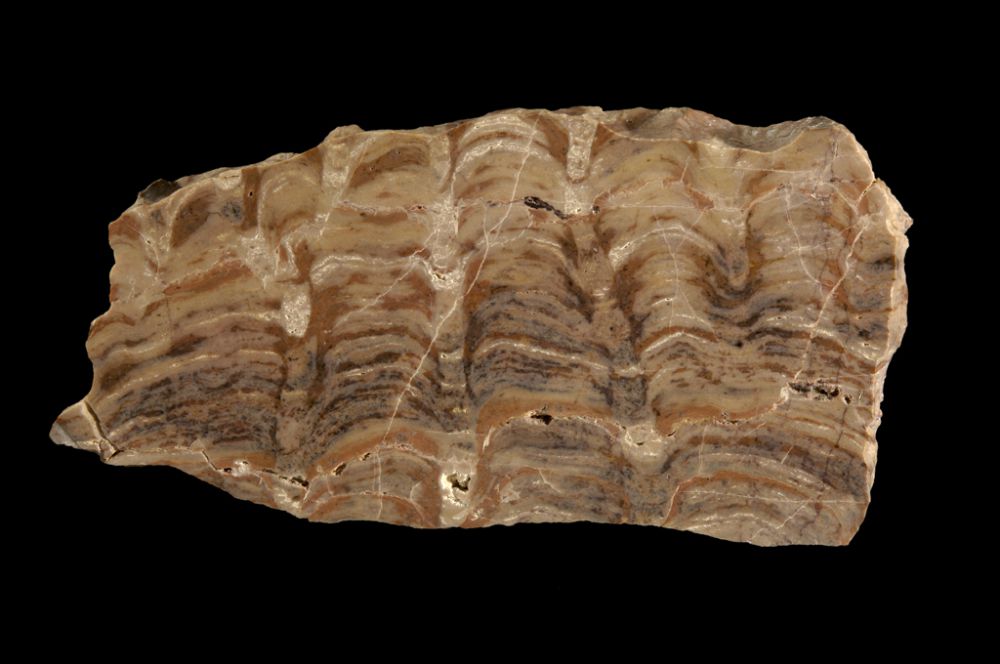
Foto: Collection Museon-Omniversum, Coll. nr. 82931
Cambrian Period, 542 to 488 million years ago: the Cambrian Explosion
Some animals hunt actively, while others burrow into the seabed, creating complex tunnel systems. As the number of predators in the oceans increases, certain fish develop protection in the form of bony plates and scales. Predators in turn evolve more effective hunting tools, while other species respond with new ways to defend themselves. This marks the beginning of an evolutionary arms race in the animal kingdom, a process that continues to this day.
The land is still bare, with only algae growing along the edges of the seas.
A Jawless Fish as a precursor
Lancelets closely resemble Pikaia, a fish that lived over 500 million years ago. Both Pikaia and lancelets belong to a group of organisms with a notochord, a transparent fluid filled rod running along the back. From this group, all vertebrates eventually evolved, including us.
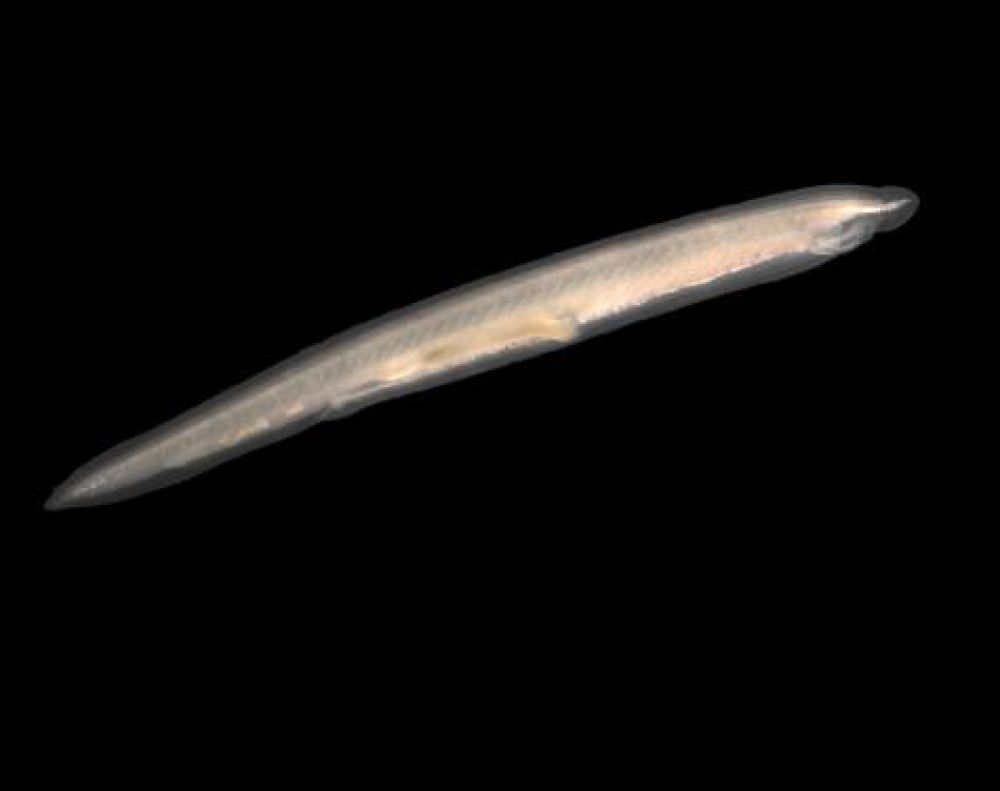
Foto: Hans Hillewaert / CC
Ordovician Period, 488 to 444 million years ago: life becomes more abundant
Fish are still jawless and covered with external armor. They hardly resemble the fish we know today. They are small, not even bigger than a herring.
Life continues to spread in the shallow coastal waters. Sea scorpions, such as Eurypterus, become common and grow to impressive sizes. They will survive all the way until the end of the Permian.
Silurian Period, 444 to 416 million years ago: the conquest of land
Before the Silurian, the land was empty and rocky, with bare stretches of sand, gravel, and clay. During the Silurian, algae mats begin to form in wet areas along seas, rivers and lakes. Providing a surface for spider-like animals to crawl on.
By the end of the Silurian, land plants begin to appear, such as Cooksonia. These are the first plants adapted to life on land. They must protect themselves against drying out, to transport water to all parts of the plant they develop vascular tissues. They also need enough structural support to remain upright. Reproduction takes place through specialized organs that produce spores, allowing them to spread beyond the water. In many ways, they still resemble their ancestors, the algae that dominate the waters.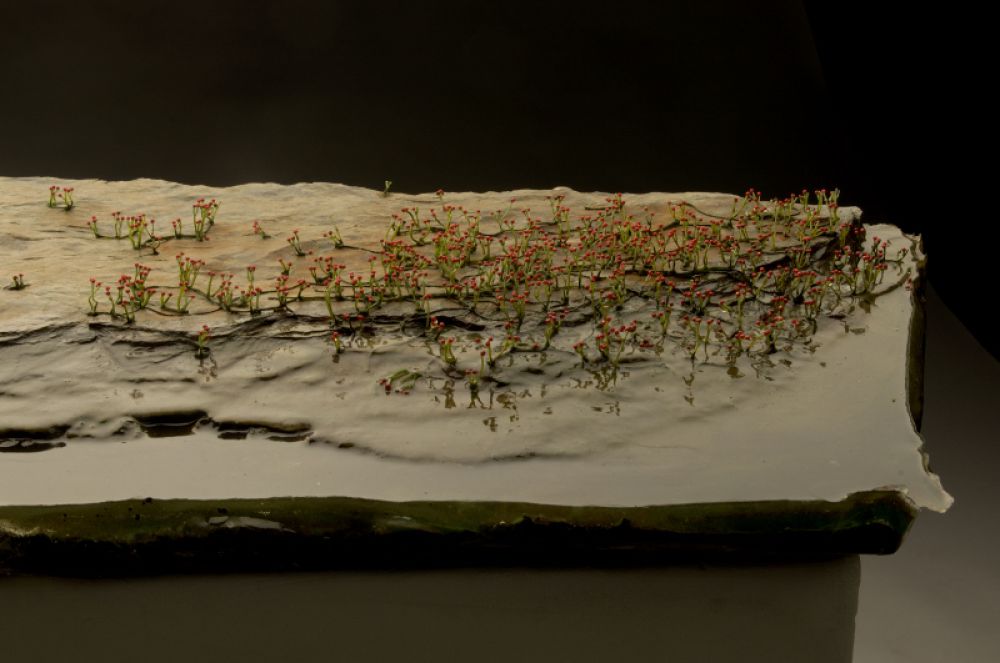
Foto: Cooksonia, Collectie Museon-Omniversum Coll. nr. 234618
These plants are very small, only a few centimetres tall. From the sediments in which they are found, researchers conclude that they grew along rivers or seashores and were regularly flooded. How they anchored themselves to the ground is unknown. They probably had no roots, but instead spread across the soil with growing stems.
The oldest Cooksonia specimens have been found in Ireland and date back 425 million years. Cooksonia grows taller than mosses and can thrive in drier areas, thanks to a vascular system that transports water to the upper parts of the plant.
Devoon, 416 to 359 Million Years Ago: Changes in the Air
In the oceans there are sharks that do not have a bony skeleton, instead their skeleton is made of cartilage.
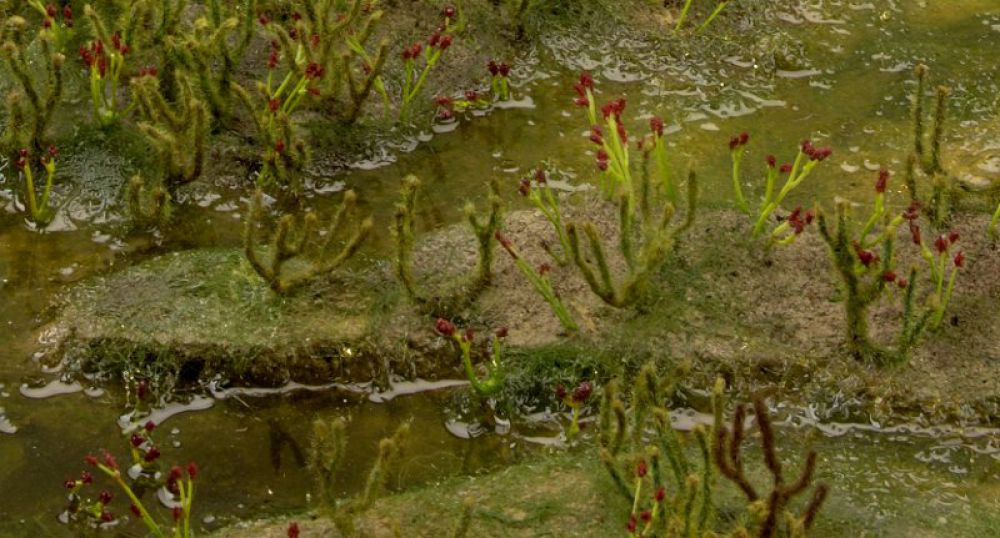
Foto: Rhynia en wolfsklauw, collection Museon-Omniversum
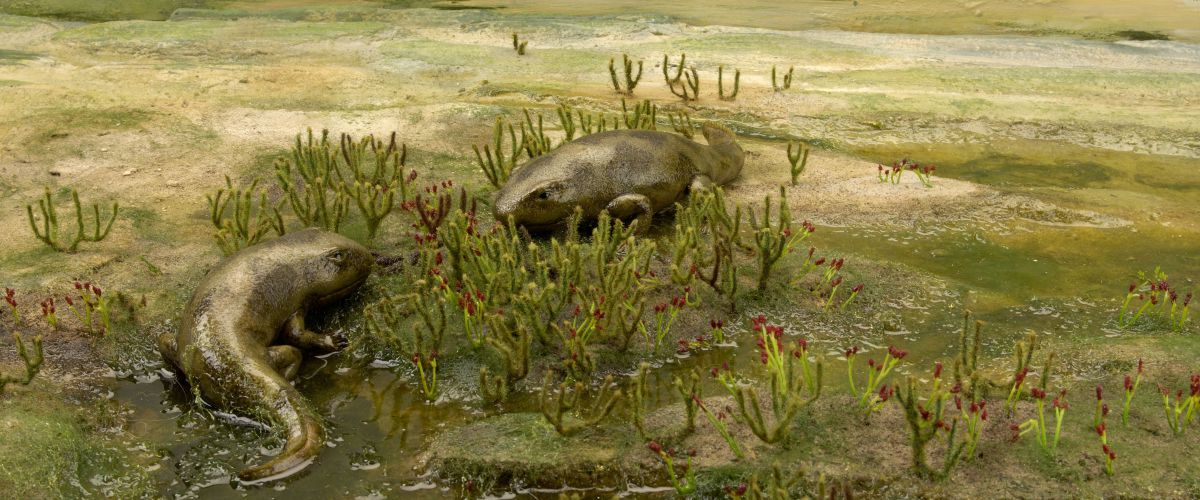
(Foto: Diorama van Ichtyostega, one of the first land animals. Collection Museon)
Long after invertebrates like millipedes left the water, the first vertebrates ventured onto land. They have lungs, the four limbs of a land animal and the tail fin of a fish. Ichthyostega is a striking example of a transitional form between aquatic and terrestrial animals. Fossils also show that its hind limbs had seven toes, while the front limbs are not completely known.
Carboniferous, 359 to 300 million years ago: exotic forests with tree ferns
In the water, placoderms are past their peak. The fish of both saltwater and freshwater increasingly resemble those we see today, but not entirely yet.
Permian, 300 to 250 million years ago: a massive catastrophe
Reptiles resembling early mammals begin to appear. Due to the dry climate tree ferns decline, making way for conifers. A well known example is the ginkgo, which still exists today. At the end of the Permian, sudden and dramatic changes occur. A massive catastrophe causes 70% of all land species and 95% of all marine species to go extinct.
The first reptiles land
Back to the water
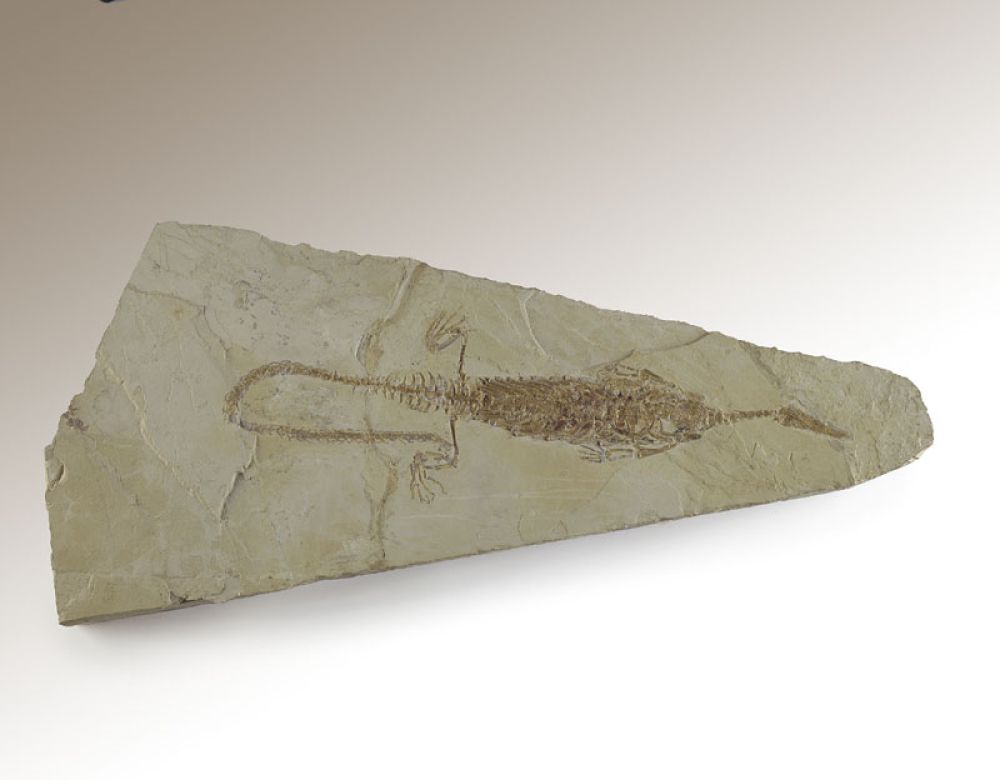
Foto: Mesosaurus, Collection Museon-Omniversum, Coll. nr. 86804
Triassic, 250 to 200 million years ago: the first dinosaurs
The swim bladder is truly revolutionary. Without it fish sink to the bottom if they stop swimming. Most bony fish have one. By adjusting its contents -air or oil- a fish can rise, sink or hover in the water without any effort. In some species the swim bladder is connected to the ear, acting as an amplifier. In others it amplifies the sounds they produce.
Jurassic, 200 to 144 million years ago: the age of dinosaurs
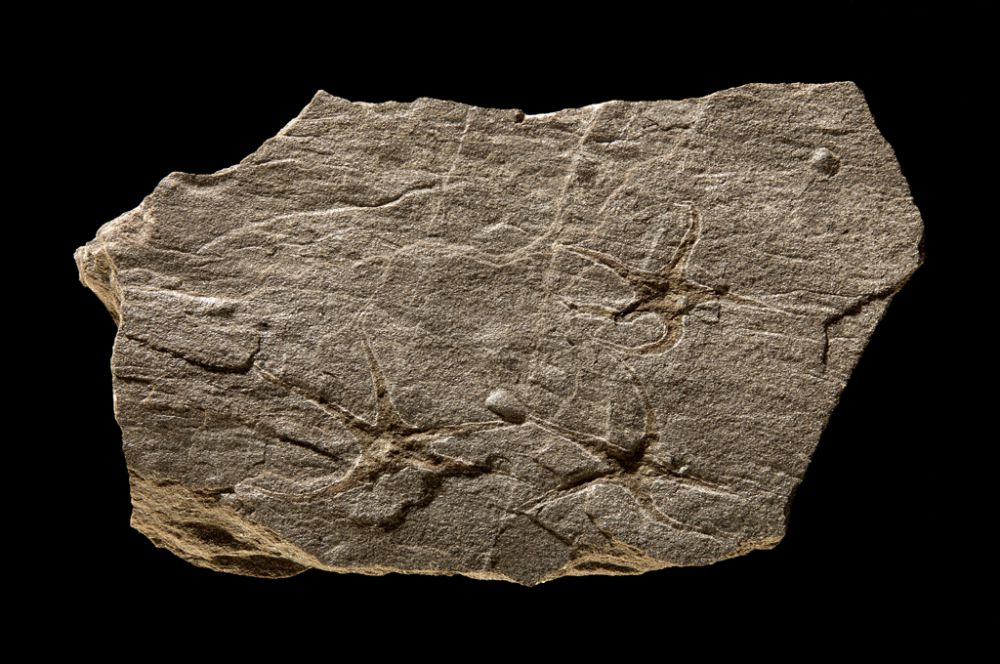
The seas are highly diverse. After the first cartilaginous fish the sharks appeared in the Silurian, rays emerge 200 million years later. Many species of bony and cartilaginous fish swim in the oceans. Marine reptiles such as plesiosaurs and ichthyosaurs become common. Above the water flying reptiles soar and the first birds begin to appear.
Cretaceous, 144 to 65 million years ago: continents flooded by shallow seas
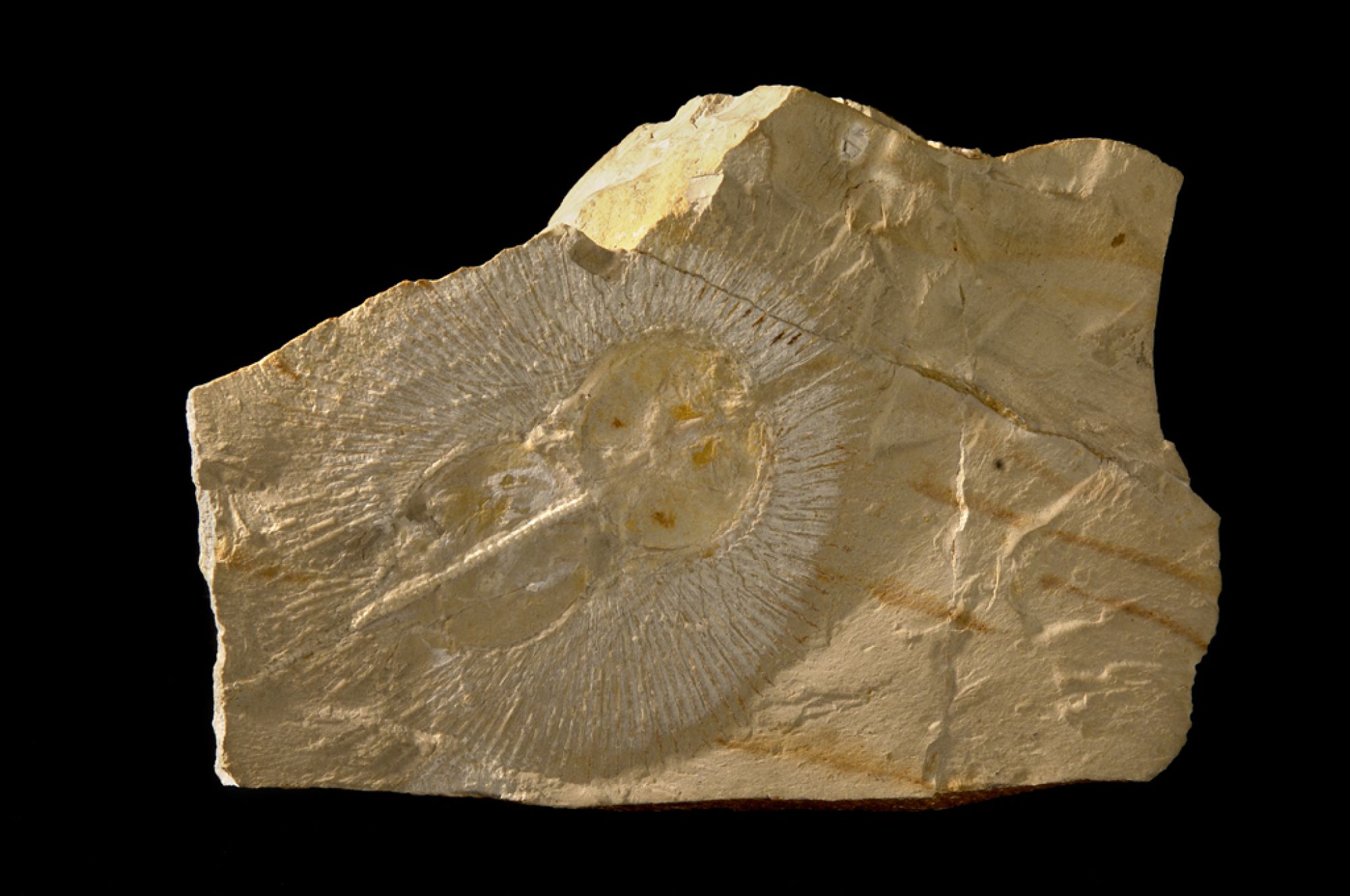
Large parts of the former continents are covered by shallow seas. Dead algae form thick layers of chalk, giving this period its name. Life in the seas is diverse and increasingly resembles that of today. On land reptiles, insects and flowering plants are abundant, while more species of birds and small mammals begin to appear.
At the end of the Cretaceous, many species go extinct, from the largest dinosaurs to the tiniest sea creatures. This was likely caused by the impact of a massive meteorite. With this event, the Mesozoic era comes to an end.
Tertiary, 65 to 1.8 million years ago: the age of giants
In what is now the United States, large areas of land were pushed upward around 50 million years ago. The regions between these mountain ranges filled with water, forming vast lakes that resembled inland seas. The fine grained limestone and clay deposits, known as the Green River Formation, are a treasure trove of fossils. On land plants and animals begin to resemble those of today. The landscape is home to giant flightless birds and various giant mammals, such as long necked rhinoceroses and elephants. The first humans appear in Africa at the end of the Tertiary.
Quaternary, 1.8 million years ago to the present: we are bony fish!
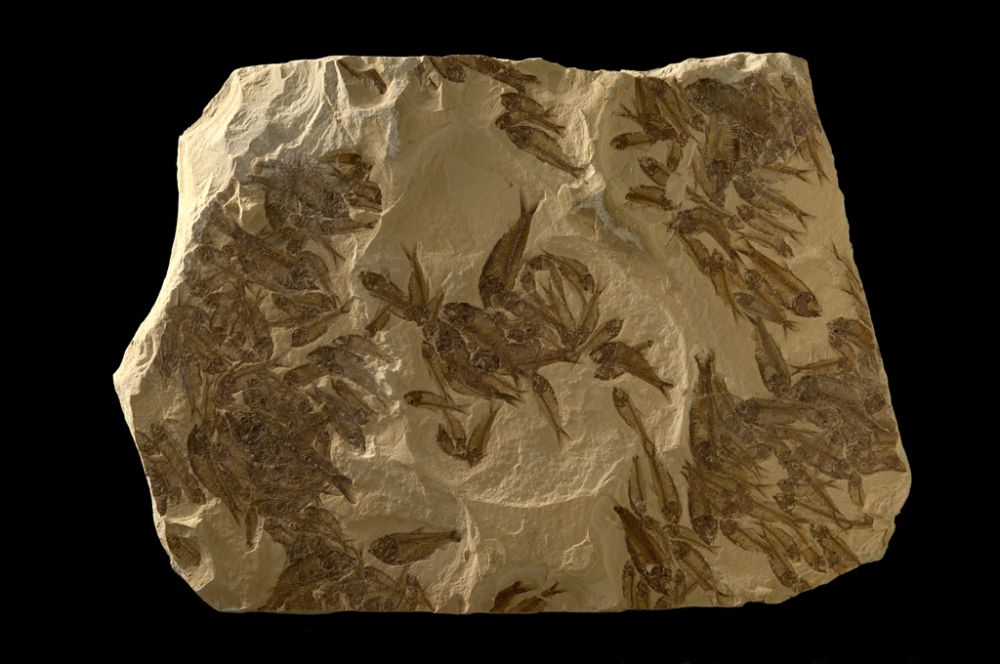
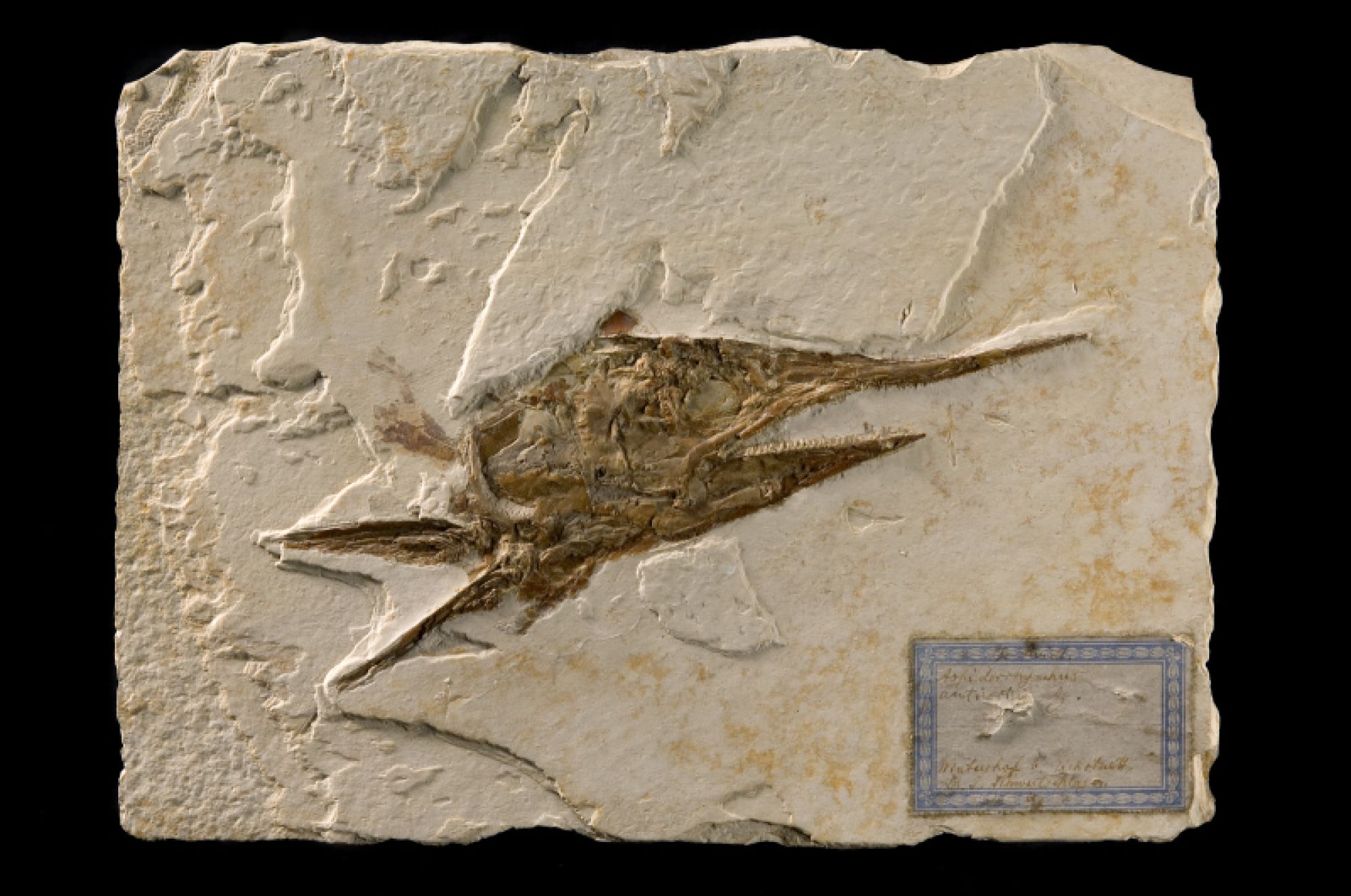
Photo: Gosiutichthys parvus. Age: Tertiary | Collection Museon
Since Darwin we have seen ourselves as part of the primates, mammals, tetrapods, vertebrates, or chordates certainly not as fish. We have no fins and would drown underwater. And yet while we do not look very fish like, if we go back far enough back in evolution the trail leads to bony fish.
Museon-Omniversum 2026


