Coelacanth, a living fossil

Knowledge

For a long time only fossils of this fish were known, but more than seventy years ago a living specimen was discovered.

As early as the Devonian, coelacanths were already swimming in the oceans more than 400 million years ago. Studies of fossil coelacanths show that they have changed very little over time. Most species lived during the Triassic, about 140 million years after their first appearance. At the end of the Cretaceous, around 65 million years ago, they are believed to have died out along with the dinosaurs.

At least that is what was believed, until a living coelacanth was caught in 1938 in South Africa. The catch was shown to Marjorie Courtenay Latimer, curator at the East London Museum. She did not recognise the fish and sent a sketch along with a first description to a fish specialist. Excitement spread quickly. Teletypes carried the news around the world. A 'Lazarus fish' a long-extinct species, suddenly found to be alive and well.

Marjorie Courtenay Latimer with her coelacanth

Marjorie Courtenay Latimer And Coelacanth

New catch

After a coelacanth was caught in South Africa in 1938, things stayed quiet for a long time. Fourteen years later, researchers discovered new coelacanths in the Comoros. As interest grew and more research funding became available, 25 additional fish were brought to light at two locations in South Africa alone. It is expected that more coelacanths will still be found in the Indian Ocean. Despite this and as a precaution to keep public attention under control, the species has been placed on the endangered species list.

Fishmarket

On 30 July 1998, the journal Nature reported the capture of a new coelacanth, this time near the volcanic island of Manado Tua in North Sulawesi, Indonesia. This population of coelacanths lives about 10,000 kilometers from the Comoros, which came as a new surprise. The Indonesian coelacanth is probably the same species as the one found in the Comoros. It appears that multiple populations in the Indian Ocean have survived through both the Tertiary and Quaternary periods. For the local population however, this fish was not unknown. A year earlier it had already appeared at the fish market under the name 'raja laut', meaning 'king of the sea'.

Living fossils

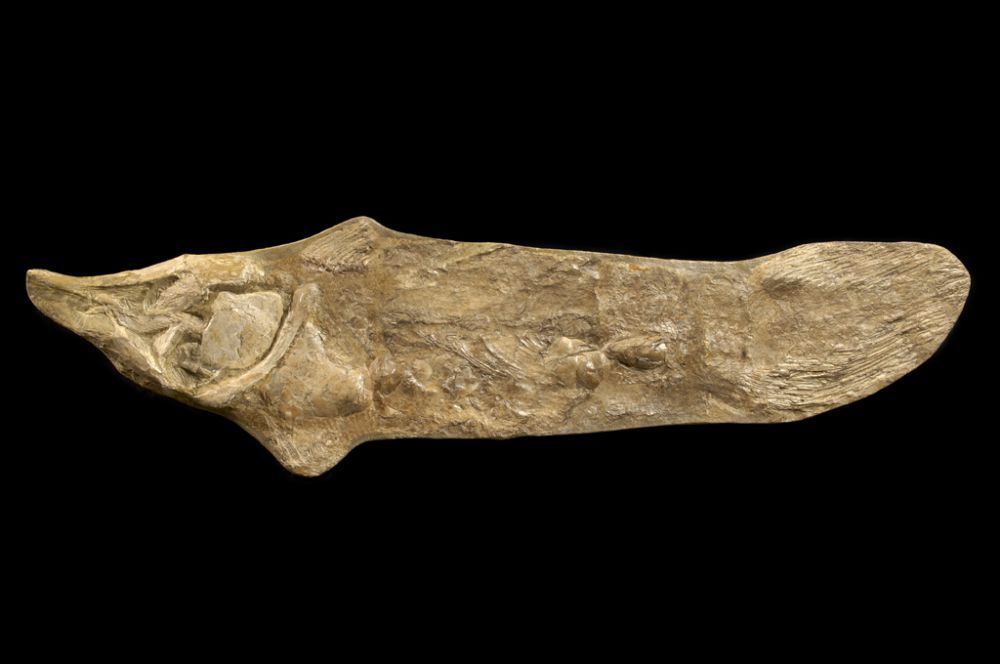
Photo: Fossil coelacanth, Axelrodichthys araripensis Maisey, 1986. Russia, Ordovicium 


When a species resembles an animal that has long been extinct, we speak of a 'living fossil'. These are unique because they have managed to survive for such a long time and there are no longer any close relatives of their kind still alive. For that reason, sharks for example, are not considered living fossils. The modern Coelacanth lives in the same environment as it did 65 million years ago and its surroundings have changed very little over time. Even so, this species is not exactly the same as it was back then. Spot the differences…

How does a coelacanth swim?

The Coelacanth is a slow-swimming fish that tends to stay within a small area. Only when it spots prey or senses danger does it swim in the way most other fish do. It then builds speed using powerful movements of its tail and rear body. The front dorsal fin can be raised and lowered, helping the fish maintain its balance in the water.

The pectoral and pelvic fins are highly flexible. They can move not only forwards and backwards, but also rotate around their axis. Although these paired fins can move independently, much like the limbs of four-legged land animals, they have never been observed being used for movement along the seafloor. A particularly unusual behaviour is 'headstanding'. The Coelacanth tilts its head downward and remains in this upright position in the water for a few moments. The meaning of this behaviour is not fully understood. It may be related to the function of an electrical organ located just beneath the upper lip. In this way, the fish might be able to detect prey and other coelacanths.

No eggs

Most fish produce eggs, often releasing thousands - or sometimes hundreds of thousands - into the water at once. Ocean currents spread them widely, allowing them to drift far from where they were laid. Reproduction in the Coelacanth works differently. The eggs do not hatch in the water; instead they develop inside the mother’s body and the young are born from the womb of the mother. This means that the juvenile fish grows up in the same area where the mother lives. As a result, the coelacanth has great difficulty expanding its range.

A far acnestor

The Coelacanth is closely related to lungfish. Lungfish began moving onto land around 350 million years ago and all vertebrates that live on land today: amphibians, reptiles, birds, mammals and humans as well descend from them.

Take a look at the lungfish collection of Museon-Omniversum

De Coelacanth ofMuseon-Omniversum

The Coelacanth of Museon-Omniversum is a plastic cast of the original copy of the Latimeria chalumnae Smith, 1939 (Coelacanth) from the aquarium in Liège, Belgium.
Inventory number : 163636

At display in the Tijdreistheater (Time travel theater)

Coelacanth